


On the afternoon of Oct. 8, the People's Bank of China (PBOC) issued a policy stance on the RMB exchange rate -- a systematic statement on the currency issue. The term "policy stance" refers to an official text issued in the name of the state, representing the official position in external communications.
To understand it, one must look at the international context. Recently, certain countries have claimed the RMB is undervalued and even sought to force its appreciation through non-market means. China's statement provides a clear basis for clarifying the issue.
The document makes three concerns clear. The first is the exchange rate question itself. Arguments that the RMB is undervalued usually carry two assumptions: that China "manipulates" its currency, and that pushing the RMB higher would weaken China's export competitiveness.
China's first concern is that all countries should respect one fact: the exchange rate is the result of multiple factors. The document states at the outset that China operates a managed floating exchange rate regime based on market supply and demand and with reference to a basket of currencies, and insists that the market play a decisive role in exchange rate formation.
A notable phrase is "managed floating": floating means no preset target level and no intervention in long-term trends. The document cites two reference points -- the 2008 global financial crisis and July this year, when the yen fell to a near 40-year low against the dollar and prompted joint intervention by relevant countries. In short, China manages with reference to international rules and practice.
Over more than two decades of exchange rate reform, the RMB has appreciated 23 percent against the dollar cumulatively, experiencing three appreciation cycles and three depreciation cycles since 2010.
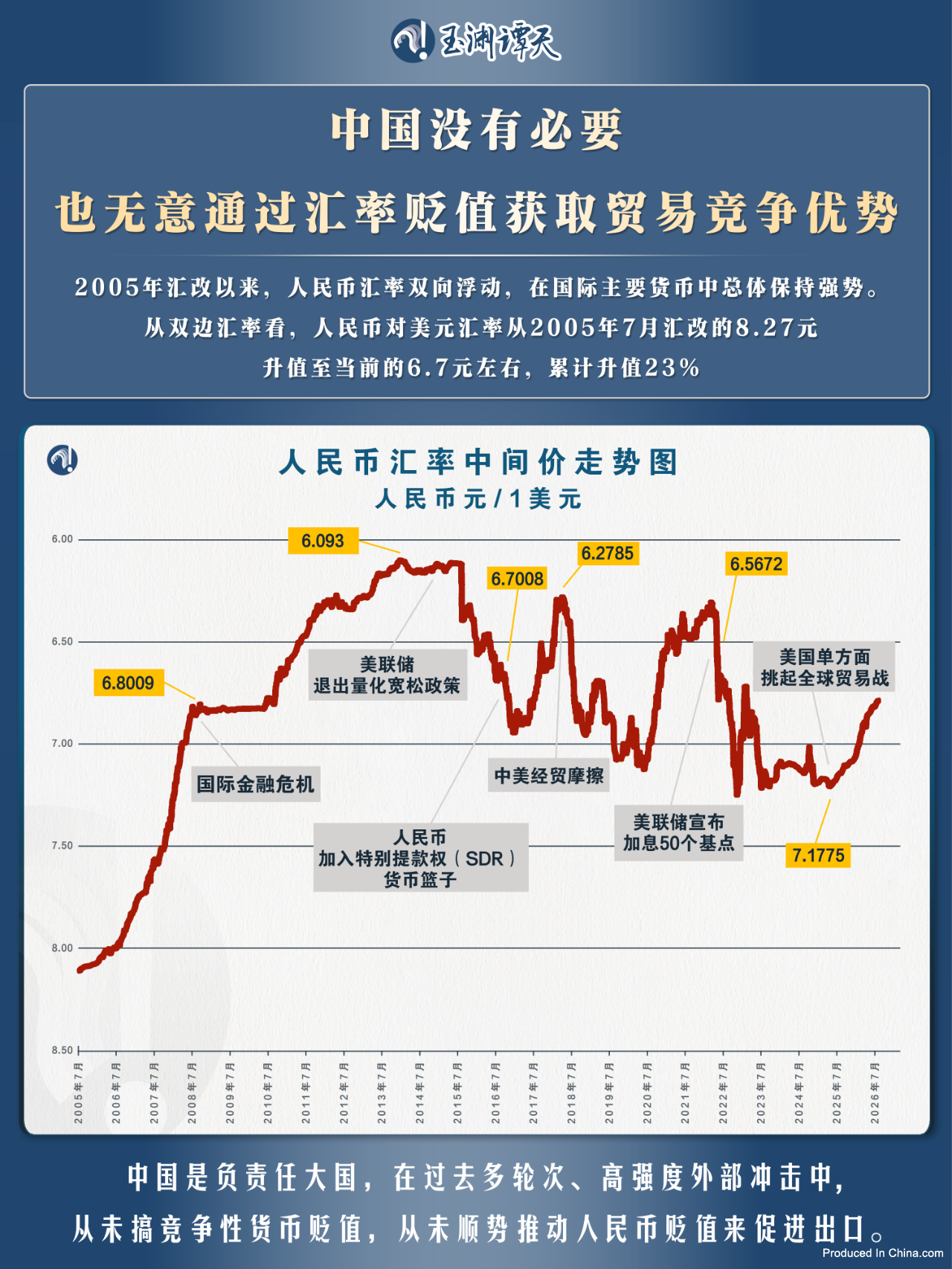
Xu Peng, deputy director of a division at the Chinese Academy of Macroeconomic Research, said the notion of "currency manipulation" is groundless. This year, both onshore and offshore RMB rose past the 6.7 mark against the dollar. While neighboring currencies weakened, China did not resort to beggar-thy-neighbor competitive depreciation, behaving as a responsible major country.
If the logic of Western critics were right and China's export competitiveness came from deliberately weakening the currency, they would be misreading China's industrial situation. Guo Kai, president of the China Finance 40 Research Institute, said forcing RMB appreciation puts the cart before the horse and would hurt other economies.
One study of firms found that after a 10 percent RMB appreciation, export prices denominated in RMB fell by less than 0.5 percent. The claim that appreciation erodes competitiveness is a short-term, static logic. In a long-term dynamic process, and especially for China with its R&D and industrial chain advantages, Chinese industry keeps cutting costs and raising efficiency -- so the currency appreciates while competitiveness strengthens.
The second concern is imbalance. In July 2026, the IMF published its 2026 External Sector Report, assessing China's 2025 external position as "stronger" and citing a median real effective exchange rate gap of -21.3 percent. IMF reports are highly technical and easily misused: different IMF models produce different results, and the Fund itself says the figures are for discussion and reference, not a strict basis for assessment.

