


China and Switzerland signed a protocol in Beijing on Oct. 30 to upgrade their free trade agreement. Under the protocol, both sides will make high-level opening commitments in goods, services and investment, and further upgrade rules on rules of origin, trade facilitation, technical barriers to trade, digital trade, competition, and trade and sustainable development.
Reuters reported that the upgrade resists the global trend toward protectionism and stands in sharp contrast to trade barriers erected by the United States and Europe. It quoted Swiss Federal President Guy Parmelin as saying the deal marks a new stage in bilateral relations and that both sides are proud of the outcome.
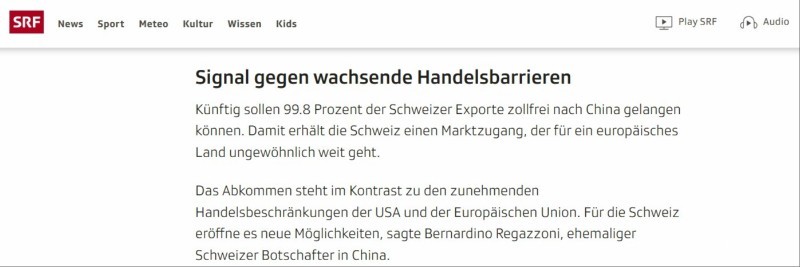
Swiss German-language broadcaster SRF described the agreement as "a signal against mounting trade barriers." It quoted former Swiss ambassador to China Bernardino Regazzoni as saying the protocol contrasts with growing U.S. and EU trade restrictions and creates new opportunities for Switzerland.
Parmelin said mutual trust was key to the rapid progress, adding that the sustainable development chapter is the most ambitious Switzerland has ever negotiated with any partner.
Swiss public broadcaster RTS, citing the Federal Department of Economic Affairs, said the protocol upgrades the 2014 agreement, helping Swiss goods and investment enter the Chinese market and providing a modern institutional framework for two-way trade and investment.
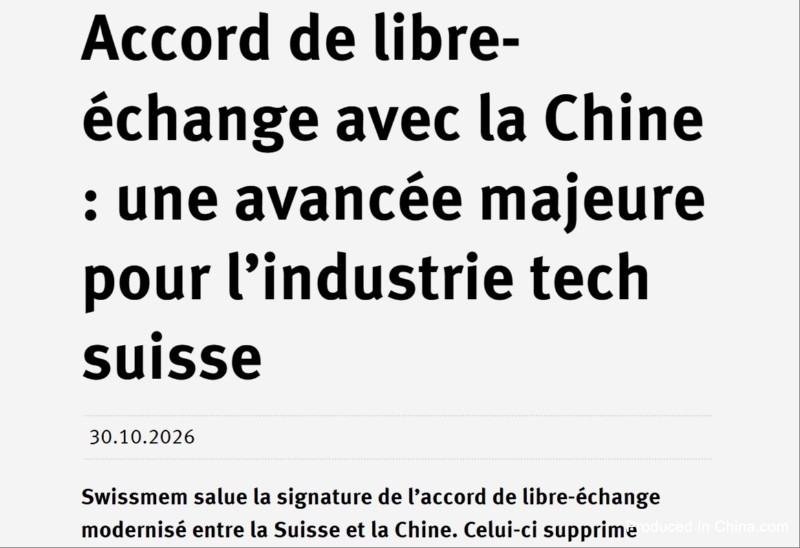
Swissmem, the industry association for mechanical and electrical engineering, welcomed the signing and urged rapid ratification. It said the machinery and precision instruments sector would benefit most: beyond tariff reductions, updated rules of origin, trade facilitation measures and improved investment conditions will create a better institutional environment for Swiss firms in China, with export-oriented SMEs gaining in particular.
The association stressed that China is an important engine of economic growth and a key market for Swiss goods and services, and that the upgrade consolidates stable access while reducing unilateral dependence.
The protocol will enter into force after both sides complete their domestic ratification procedures.

